Pages

Friday, November 12, 2010

Bible Cake


While researching the history of food during World War Two (for a Culinary Historians of Atlanta event), my friend Chef Christy Seelye-King ran across a 1947 recipe for Bible Cake. It’s really more of a puzzle than a recipe. Each ingredient must be gleaned from Biblical verses. The recipe was published in the “Olio” Cookery Book in England. It’s easy to imagine a scene in one of those stark black and white English movies of the 1940’s. An English housewife, who always wears an apron, is trying to figure out the recipe for Bible Cake, printed in the Sunday newspaper. Her husband is away at war, and she is single-handedly keeping her household going. The Bible Cake recipe-puzzle serves as a comforting distraction.

I wondered about Bible Cakes. Was this idea invented during World War Two, or did it go back a-ways? Turns out I didn’t have to look very far. The answer is in the fine blog, Hushpuppy Nation, written by the food journalist, Rick McDaniel. The earliest Bible Cake recipes are to be found in cookery books published in England during the late 1700’s. The war between England and its American colonies didn’t dampen the enthusiasm that women had for Bible Cakes. None other than Dolly Madison was said to be a fan. Here is a link, with recipe, to the article about Scripture Cake in Hushpuppy Nation. http://www.hushpuppynation.com/scripture-cake/

And here, for your amusement, is the recipe for Bible Cake, published in 1947, in the Olio Cookery Book. Good luck with it!

Bible Cake 
 Look up the references and work out what’s required.  It won’t taste too good if you get it wrong!
1.     225g (1/2 lb.) Judges V, verse 25 (last clause)
2.     225g (1/2 lb.) Jeremiah VI, 20
3.     15ml (1 tbsp) I Samuel XIV, 25
4.     3 of Jeremiah XVII, II
5.     225g (1/2 lb.) I Samuel XXX, 12
6.     225g (1/2 lb.) Nahum III, 12 (chopped)
7.     50g (2 oz) Numbers XVII, 8 (blanched and chopped)
8.     450g (1 lb.) I Kings IV, 22
9.     Season to taste with II Chronicles IX, 9
10.  a pinch of Leviticus II, 13
11.  5ml (1 tsp) Amos IV, 5
12.  45ml (3 tbsp) Judges IV, 19

(Hint: ‘leaven’ means ‘baking powder’ and you may need to add some Exodus III, 14 to moisten the mixture)

Beat 1, 2, and 3 to a cream; add 4, one at a time, still beating; then 5, 6, and 7, and beat again.  Add 8, 9, 10 and 11 having previously mixed them, and lastly 12.  Bake in a slow oven for 1 ½ hours.  

Ps - If you want a recipe that comes with the answers, click here. 


Thursday, November 4, 2010

Be the Ultimate Locavore: Eat Forgotten Foods

Chickweed - new gourmet darling -- and free, too!


Do you ever stand in the produce section of your local supermarket, feeling tired of the same old green beans, squash, and lettuce? Are those gourmet fruits and vegetables just too expensive? Are you trying to do a better job of eating locally-grown foods?

Here's an idea - start eating the forgotten foods that are growing all around you. There are hundreds of plants that people have eaten for thousands of years that go begging every day. These are fruits and vegetables that are tasty and nutritious. They were popular foods before people started farming, and even after most people turned to agriculture they enjoyed these wonderful plants that shared our habitats. The only problem is that people stopped eating them. And the reasons people stopped eating them had more to do with demographic and economic changes in society -- it had nothing to do with flavor or usefulness.

Nowadays, we call them weeds. We waste money on harmful herbicides to kill perfectly delicious and nutritious foods that are growing in our own gardens, yards, and window boxes. Our problem is that we just don't know about them.

Well, I've been eating edible wild plants for 40 years now, and I'm here to tell you they are some of the most interesting foods around. I've even been hoping that the current economic downturn will serve as a source of encouragement for adventurous cooks to venture forth into their yards and learn to eat their weeds. Not all weeds are edible, but many more of the weeds in the average suburban yard are edible than are the ornamental plants, many of which are deadly poison. If you only learn -- and use -- five edible wild plants on a regular basis, then you, too, could save money and reduce your environmental footprint substantially.

A few evenings ago, I was invited to give a presentation on edible weeds to the local Master Gardener's group in my home county. Click on the link to see my PowerPoint presentation.

http://apps.facebook.com/slideshare/slideshow/5647297?from=slidespacevio

Please, dear readers, let me know if you would like more information on this topic. In fact, to encourage you to comment,  starting this month I will hold a free giveaway to one lucky person who posts a comment to this blog. The winner will be chosen at random, so comment early and often.

Friday, October 29, 2010

Corn-y Halloween!

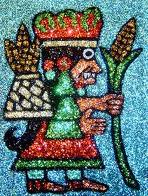
Chicomecoatl,  Aztec Corn Goddess


Happy Halloween 2010!

The meaning and practice of this ancient holiday has changed drastically over the 2000-years-plus of its existence -- but there is something about the fall festival that's irresistible. Maybe it's the weakening of the sun, the falling leaves, or the weird combination of death and sweetness that calls on those of us in the species Homo sapiens sapiens to take to the darkness and celebrate our own dark side.

The roots of Halloween grow in the British Isles and northern France, the ancestral homeland of the Celts, who also brought us Stonehenge and the Druids (good name for a rock group). In the Celtic calendar, the harvest signified the end of the year, and fell during late October, according to our calendar. The fields were cleared and the stubble was piled up. People extinguished the flames in the family fireplace, and everyone came out to the fields to burn off the old stubble, tell fortunes, feast and otherwise celebrate the old year, a festival known as Samhain. At the end of Samhain, everyone lighted torches from the now-dying bonfires and took them home to re-light their home fires. 

After dark, things got creepy, because the old year ended at sunset. The new year wouldn't start until the dawning of a new day - at sunrise the next morning. During the hours betwixt dark and dawn, the boundaries between the world of the dead and that of the living were blurred. That meant the dead were free to roam the land. The dead were a hungry bunch and seemed to prefer sweet foods. Back then, that meant apples and other fall fruits. People dressed up like the dead -- like skeletons, ghosts, goblins, and ghouls, so that they could fit in with all the dead people wandering around looking for mischief. People carved special lanterns with scary faces to help their disguises. These jack-o-lanterns were usually carved from turnips. Pumpkins came later, from a New World that the Celts didn't know about. 

Halloween is still celebrated in the old Celtic lands, but it's not that big a deal. No, Halloween has reached its zenith in America, where it is a secular event that celebrates our unique way of mixing and mashing cultures into new forms. I already mentioned replacing turnips for jack-o-lanterns with the much superior pumpkin. Consider corn, more accurately called "maize".

Betty Fussell, American Corn Goddess
Corn is the basis of all American cuisine. If you doubt that statement, I suggest you read The Story of Corn, by the distinguished food writer Betty Fussell.  Maize was domesticated by the Aztecs at least 8,000 years ago, in what is now southern Mexico. Maize spread quickly throughout North America and into South America. By the time the European settlers arrived, most Native Americans had stopped hunter-gathering and switched to growing maize and other crops, including beans, squash, chile peppers and tomatoes. Pumpkins are a type of squash.

Settlers from the old Celtic lands brought their Halloween traditions, such as carving jack-o-lanterns and dressing in scary costumes and wandering around in the night trick-and-treating. But corn -- and the corn harvest -- coincided time wise, and became part of the fall celebration, hence Indian corn was used as a decoration and popcorn balls quickly became a Halloween treat.

Enter that very special and distinctively American sweet, candy corn. Now candy corn was invented in the 1880's by a German candy maker who had immigrated to the US and ended up living in Illinois, surrounded by cornfields. Of course, in those years, most Americans lived on farms or in small towns. They got a kick out of the marzipan-like candy that looked like corn. The big sensation in candy corn was that every kernel had three colors! The inventor had figured out a way to use corn starch (!) to keep the sections of hot sugar syrup separate as they cooled. So there is real corn in candy corn. What a sensation!

These days, we take a ho-hum attitude toward candy corn here in the US. But in some parts of the world, it's special. One of my favorite food bloggers, who goes by the mono-name, Adrienne, is an anthropologist-turned-writer in London, England.  She is fascinated by those American foods, popcorn and candy corn, and recently posted an article in her witty blog, Coffee in a Teacup.  She also developed a recipe that combines popcorn and candy corn. Here it is, for your Halloween enjoyment. Even if you don't try to make it, at least read her description of making popcorn - something we Americans take for granted.

Candy Corn and Candied Corn (adapted from Cooking Light)

¼ cup butter
8 cups popcorn (I did mine on the stove to make it slightly healthier but microwaved is fine too)
8-10oz/ 200-300g marshmallows
a good sprinkling of salt
1 cup+ candy corn

Method:

Make your popcorn.  I made mine by coating a medium sized pot with sunflower oil and heating it over the stove, making sure to coat the entire bottom and onto the sides.  Then add 100g corn maize kernels and cover with a lid, lightly shaking the pot from side to side.  Continue to shake the pot while the corn pops (you can hear it- it's very exciting!) - this not only helps the unpopped kernels to cook, but also keeps the freshly popped corn from burning.  You know the corn is popped when you can no longer hear or feel many raw kernels, and when there is a lull of 5 or more seconds.  Transfer your popcorn to a large bowl and sprinkle generously with salt.  Next add your candy corn to the bowl, taking care not to let them all sink to the bottom.  You'll want them spread evenly throughout your mix if possible.


In a small saucepan, melt your butter and marshmallows with a dash of salt over a low flame, stirring periodically as it begins to melt.  Do not allow it to bubble.  Once fully melted remove from heat and pour the melted mixture over your popcorn.  Mix thoroughly trying to evenly coat all of the corn.  Let cool for 5 minutes.


Line a baking tray (or two) with grease proof paper.  When your mixture has cooled, spray your hands with cooking spray first, then take a handful and squeeze the mixture together to form balls slightly smaller than tennis balls.  The marshmallows will work as glue allowing you to press tightly to form compact balls.  You may have to respray your hands every couple times, as the mixture is incredibly sticky!  Leave to dry/set on the baking tray for 30 minutes or so.  Then wrap the balls individually in clingfilm and give away as soon as possible (they probably will only keep for about 3 days or so) to anyone in need of a bit of Halloween cheer, perhaps reminding them about good dental hygiene as these things will certainly stick in your teeth... in a good way of course!

Monday, October 18, 2010

Coca-Cola: the Controversy Continues

Mural in Guatemala, where Coke has been accused of union violence


ATLANTA - Atlanta was destroyed in the Civil War, and the mere fact that it came back stronger than ever is amazing, considering that other places simply disappeared. If you ever take a ride on quiet country highways in Georgia and South Carolina, stop at the historical markers that stand at places in the road where there is nothing to see but a vacant field -- sometimes an old wooden church is all that remains, sometimes a few scattered chimneys. Those historical markers tell the tale of towns that once stood there. A few months ago, the Culinary Historians of Atlanta had a picnic where the thriving town of Etowah once churned. Now it's a lakeside recreation area.  Nothing is left but the chimney from the old pig iron furnace that was the town's main industry.

But Atlanta was different.  One of the things that helped Atlanta's economy was the invention of an elixir called Coca-Cola. A pharmacist named John Pemberton first concocted the stuff in 1886. The company that was created to mass market the drink, which originally contained cocaine (the "coca" in "Coca-Cola") aggressively pursued profits, which was a good thing in the impoverished South. It made many families wealthy. They, in turn, donated dividends and even Coke stock to local institutions, which still benefit from the generosity the company shows to its shareholders. Some people even claim that Coca-Cola saved Atlanta single-handedly.


The Coca-Cola Company may be good to its executives and shareholders, but there is another side to the story. It has been accused of making Americans fat (the company invented high-fructose corn syrup in the 1980's), of polluting the water in Third World Countries, and of sanctioning acts of violence against workers trying to form unions in developing economies.

Now there's yet another in a long line of books about the company that accuses it of the worst crimes imaginable, including murder. Here is a link to a book review from TheAtlantic.com. Briefly, the reviewer, Daniel Fromson, who is also the producer of The Atlantic's food channel, states that the book is interesting and very readable. He also warns, however, that it is a little one-sided, against the corporate giant. 

The book is titled, The Coke Machine: the Dirty Truth Behind the World's Favorite Soft Drink. The author is Michael Blanding, a political writer who specializes in political exposes and travel.


The story of Coca-Cola and other giant profiteers that sell the food we rely on for health is informative to the culinary historian, in that the way people eat these days has changed from the times when people grew their own foodstuffs or purchased foods directly from farmers or small bakers. It is vital that we, as food-loving bipeds, stay informed so that every time we enter a supermarket we can make intelligent food-purchasing decisions.

http://www.stumbleupon.com/su/1WQAQn/www.theatlantic.com/food/archive/2010/10/the-pause-that-represses-coca-colas-controversies/64456//r:t

Saturday, September 18, 2010

Will Tweet for Food


ST. PETERSBURG, RUSSIA -- The most important seed bank in the world is currently endangered by real estate developers. A Twitter campaign has won a temporary reprieve for the seed bank, but more help is needed. The future of humankind could be at stake. No joke.

Here's the story. The Pavlovsk Experimental Station was founded in 1927 by the brilliant botanist and plant geneticist, Nikolai Vavilov (my secret crush), with the goal of collecting a large amount of plant genetic material to better feed Russia and the rest of the world. Vavilov traveled the world collecting plants while developing a theory on the origins of cultivated crop plants that is still important to botanists, crop scientists, plant geographers, and ethnobotanists. Vavilov carefully chose the location for its soil and climate because it is a living seed bank. The seeds are "grown out" to keep the strains alive and grow the collection. If seeds aren't grown out, the DNA will eventually 


Nikolai Vavilov

die. Vavilov invented the very idea of seed banks. There are now more than 1,000 seed banks around the world, but Pavlovsk is the most important one, because it has more seeds than anyone of all types of plants. It is especially important for its collection of 5,000 types of fruits and berries, 90% of which are extinct, except for the collections at Vavlosk Station. 

Under Stalin, Vavilov himself was persecuted and imprisoned. His crime was that he was more loyal to science than to politics and that he was from the bourgoisie. His parents were merchants, and he was an educated person. A high crime, indeed. He also criticized Stalin's favorite scientist. whose views regarding evolution turned out to be dead wrong. In 1940, Staling imprisoned Vavilov for these "crimes".  Three years later, Vavilov died in prison, of malnutrition.  Eventually, he was vindicated. The government even issued a postage stamp in his honor. 

The scientists who work at Vavlosk Station have always been deeply committed to their work. By the time Vavilov was imprisoned, he and his colleagues had already collected seeds from more than 200,000 plant varieties. During WWII, while Vavilov languished in prison, the scientists at Pavlovsk continued their work. Even during the 900-day siege of Leningrad (St. Petersburg was called Leningrad during the Soviet era), the scientists heroically managed to keep Pavlovsk Station's work alive. Twelve of the scientists starved to death during the siege, surrounded by edible plants and seeds. They refused to eat their work. 


Rare berries at Pavlovsk

Pavlovsk has already saved the world, in a sense. After a drought in Ethiopia, and war in the Balkans wiped out crops, seeds from Pavlovsk helped farmers plant new crops to feed the populace.  In future years, with the threat of global climate change, the old crops may fail, and genetic material from seed banks such as Pavlovsk will be needed to find new crops that will thrive under different climatic conditions. Ironically enough, it's already happening. Russia is currently undergoing a terrible drought that has killed off most of the wheat crop. Already, Prime Minister Putin has issued an order to stop all wheat exports from Russia. It's time to plant the winter wheat, and farmers are trying to do so in dry soil with no promise of rain. The crop scientists at Pavlovsk, with their enormous seed collection, might be able to find a strain of wheat that can thrive in the new dry conditions. 

But Pavlovsk itself is threatened with extinction. It's a story worthy of Kafka himself. Pavlovsk Experimental Station is owned by the Russian government, on government-owned land. And even though it is the original seed bank and the most important seed bank in the world, the Russian government has refused to do the paperwork necessary to make it part of the global network of seed banks. The budget has been cut almost every year. 

Because of the budget cuts, Pavlovsk has been forced to lay people off, and the once-beautiful gardens have deteriorated. The important plants are still healthy and robust, but there are also a lot of weeds and a generally unkempt look about the place. The government that cut the budget now says that "obviously" the people who work there just don't care about the place. Nothing could be further from the truth.  They just don't have the money for such frills as paying for gardeners to do the weeding. 

Enter the Department of Housing. Now, housing is a big deal in Russia, and the Pavlovsk Experimental Station happens to be on some prime real estate (which was not the case when it was first established. It was out in the countryside.)  The government wants to turn the land over to a real estate developer to build luxury housing. The value of Pavlovsk is irrelevant to these people. In terms of the value of a priceless seed bank, here is their response, (loosely translated)--  "If it is priceless, that means one cannot set a price. So priceless is the same as worthless. It has no value. It has no worth."  I told you. Kafka-esque. 

The Department of Housing said that Pavlovsk Station could be moved. The scientists say that would take ten years, because of the mature living plants in the collection. Luckily, there is a strong connection between Pavlovsk and Kew Botanical Gardens, near London, England. The scientists at Kew put out the call. In response, the Global Crop Diversity Trust started a Twitter campaign to save Pavlovsk. Over 30,000 tweets were sent, and one week later, President Medvedev tweeted back! Pavlosvsk was given a one month reprieve, and Medvedev called for an investigation. 


Sunday, September 12, 2010

Steppin' Out


Blogging, like most writing,  can be a lonely thing. You sit staring at the computer screen and wonder if anyone is out there -- if anyone will read your digital scribbling. 


But then I attended the Food Blog Forum yesterday. It's not lonely at all. It's a cyber-community. There's ALWAYS someone to "talk" to. 


This was the first time I had come out of my shell since starting The Culinary Historian a few months ago. The forum was held at The Shed on Glenwood, a new restaurant in a rapidly gentrifying neighborhood in Atlanta. There was plenty of parking,  as most of the surrounding buildings are empty or under construction. 


One hundred other food bloggers were crammed like sardines into the too-small space, perched on the hardest little wooden chairs many of us had enjoyed in a long time. But the speakers were knowledgeable and engaging and it was wonderful to spend a day in the company of such an interesting group. 


The main speaker was Jaden Hair, of steamykitchen.com  Jaden  de-mystified blogging and shared what it takes to be a successful blogger.  In the last session of the day, she just sat in a chair and talked about her experience, what she has learned, and what works. She had no PowerPoint, no visual aids. She just sat and talked and answered questions. I learned a lot. 


The main thing that I came away with was that a good blog is entertaining and has useful information. A cooking blog is a good example and most of the other bloggers had cooking blogs. They put up cute pictures of their kids and share a recipe or two. 


I wondered, how does The Culinary Historian fit into this paradigm? My aim is to have a blog that is thoughtful and informative. But is it useful? Is it entertaining to anyone but me? 


So, dear readers (and I only have a small idea how many of you are even out there), please tell me. Should The Culinary Historian be funnier? Have more pictures of food? Offer recipes? If it has recipes, should they be old and historic or fresh and new for today's cooks? 


I really want to know and will take action based on your comments and suggestions (Jaden refers to this as "community driven"). If you don't want to comment publicly you can send me an email at deborah.duchon@gmail.com


I'm hoping to hear from A LOT of people! Thanks! 

Sunday, September 5, 2010

From Cannonballs to Coffeepots

Benjamin Thompson, a/k/a Count Rumford


First, a digression. We Americans value niceness. In our culture, it is just as important to be nice as to be good. It is not enough to do the right thing, to simply be honest and charitable. We also should be really nice. In our books and movies, the good guy is nice and pleasant. The bad guy is rude and mean. 

It is not so in all cultures.  Some years back, I attended a seminar at the East West Center in Honolulu. Most of my fellow attendees were Asian, while the instructors were American. In private, my comrades grumbled that the instructors seemed cloying and insincere. "If they have something to say," one remarked after a round of class presentations, "They should just say it." The instructors were all-American. They smiled a lot when they spoke to the class and criticism was preceded with a compliment. The Asians hated it.

In another example, before a trip to France I read up on French culture, and was struck by the separation of helpfulness from niceness. This is a problem for the French when working with American tourists, because in the French view, it is not necessary to be nice in order to he helpful. But Americans often come away from encounters with tour guides, hotel clerks, train conductors and the like feeling like they've been assaulted. Although they might have been given good information and treated fairly, the tourists didn't get the smiley face and have-a-nice-day attitude that Americans expect. 

I guess that's why I'm so fascinated with the man who started the first school lunch program for poor children. He was an amazing person -- an inventor, an innovator, a man who did many things for the betterment of society. But he was not nice. His biographers use words like "despicable" to describe him. 
Benjamin Thompson Birthplace


Benjamin Thompson (1753-1814) was born in Woburn, Massachusetts, in a home that is now a museum listed on the National Registry of Historic Places. His father, a farmer, died before little Benjamin reached the age of two. The boy was educated in the village school and soon realized that farming was not for him. He had a mind for science and studied hard. He even walked to Cambridge to attend lectures at Harvard College by the distinguished mathematician and physicist, John Winthrop. He became a teacher, and moved to Concord, New Hampshire (formerly called Rumford) to accept a teaching position in 1772. There, he met and married a wealthy widow who was 14 years older than him -- and he instantly gained the wealth and status that he craved. 

When the Revolution started, he took the side of the British. The local populace suspected that he was a British spy (which he was) and when an angry mob came after him, he fled, abandoning his wife and child, forever. He moved to Boston, where he continued his spy activities and recruited people to the British cause, until he joined the British evacuation of Boston in 1776. 

In London, he conducted experiments on gunpowder and continued his scientific studies with guns and cannons.  For his service to the crown, he was knighted. He became famous within military circles for his work with gunpowder and munitions, and in 1783, accepted the position of Major-General and Privy Counselor to the Elector of Bavaria. He moved to Munich. 
Thompson's illustration of his cannon-boring experiments


During his travels in Europe, he met an elderly lady who had a strong influence on him. All that is known of her is in one line of a letter that he wrote, that this unnamed woman "opened my eyes to other kinds of glory than that of victory in battle."  

After meeting this woman, he devoted the rest of his life to the betterment of mankind.  He stayed in Bavaria for five years and became a pioneer in the Social Reform Movement. One of the many good things he did there was found the Poor People's Institute, which provided food and work for the poor. He also started a school for poor children, which included lunch. This place was not paradise. Everyone was expected to work. And the food was basically a soup made of potatoes, peas and barley (giving rise to the term "soup kitchen").  Funding was always an issue, and Thompson learned as much as was known about nutrition in order to provide healthful, but budget-conscious meals. 
Monument to Count Rmford in the English Garden, Munich


He became famous throughout Europe for his work, and the governments of England, Germany, France, Scotland, and Switzerland consulted with him to set up similar programs.
While in Bavaria, he also came up with work programs for idle soldiers, set up the English Garden in Munich, started a veterinary school, and convinced farmers to start growing nutritious foods, such as turnips and potatoes, which, up to that time, were suspected as poisonous.

In his quest for ever more efficient ways to prepare food, he invented such things as: the double boiler, the kitchen range, the fireless cooker, the percolator, and the pressure cooker. In recognition of his achievements, he was named a Count of the Holy Roman Empire. He took on the title Count Rumford, in honor of the town in New Hampshire where his fortunes changed. 

Where would we be without the percolator?
After five years in Munich, his patron died, and, having no other friends, probably on account of his abrasive personality, he returned to London. There, he ran another feeding program, serving 60,000 meals per day. He also continued inventing things that made people's lives better. The most famous of these is the Rumford Fireplace, which made him extremely wealthy in his own right. 

The peripatetic count moved one more time – to Paris, where he lived out his life still conducting research into the nature of heat and light. In physics circles, he is remembered as the Father of Thermodynamics. Benjamin Thompson, Count Rumford, died in Paris in 1814. He left the bulk of his estate to Harvard College.

This article, although way too long by blogging standards, barely scratches the surface of the story of Count Rumford. Saint or sinner? You decide.